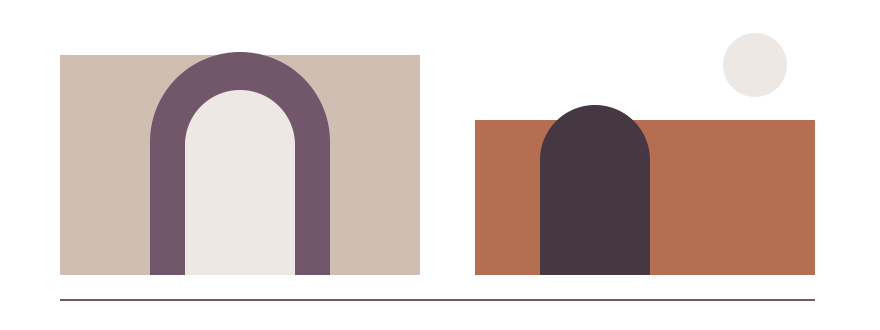
Choose a view you can observe comfortably for ten minutes. It might be a courtyard, a window, or the corner of a room. Instead of drawing everything, find three large shapes. In one recent study, mine were the pale rectangle of a wall, the dark opening beneath an arch, and the long sloping edge of a shadow.
Draw the largest shape first, leaving room around it. Add the second with attention to the gap between them. The third should help explain the relationship, rather than fill an empty corner simply because it is empty. I often discover that the gap is the real subject and the surrounding shapes are only its frame.
Use a limited palette and give each color a job. My lavender holds the quiet surface, clay gives the composition a warm anchor, and plum marks the deepest opening. These are choices for the page, not measurements of the scene. A drawing can be faithful to an experience without copying every visible color.
Before you close the book, write one specific sentence. Mine said that the shadow reached the lower edge of the doorway just as someone opened a shutter nearby. The line records time in a way the shapes cannot. On another visit, the light will have moved, and the same courtyard will offer a different page.
Leave one edge open
Try allowing a shape to continue beyond the page. The unfinished edge can make the drawing feel like a view you entered, rather than an object you collected.